
I’ve sat on both sides of this decision. For years, I built and led in-house analytics teams at Barclays and Deliveroo. I hired analysts, managed budgets, and dealt with all the overhead that comes with growing a data function inside a large organisation. Now, as an independent analytics consultant, I work with companies that face the same question I once asked myself: should we hire someone full-time, or bring in outside expertise?
The answer is rarely straightforward. It depends on your budget, your timeline, and what you actually need analytics to do for your business. This article gives you an honest, numbers-based comparison of hiring an analytics consultant vs in-house team — from someone who has lived both realities.
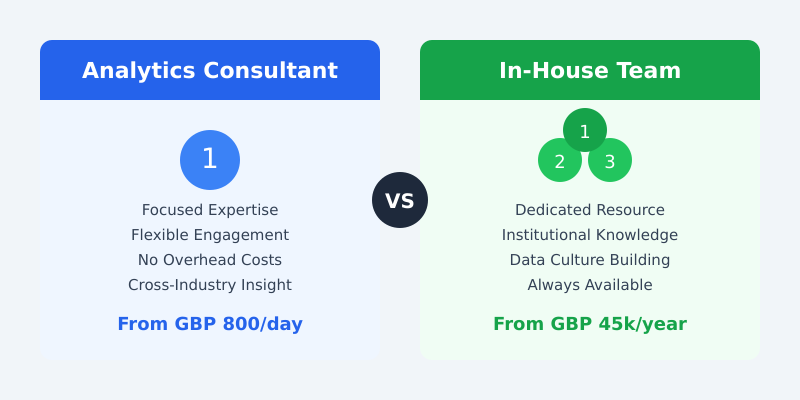
The True Cost of an In-House Analytics Team
When I was hiring analysts at Deliveroo, the salary was only the starting point. The real cost of an in-house analytics hire goes far beyond what appears on the job listing. Let me break it down using current UK market data.
According to Glassdoor UK salary data, a mid-level data analyst in the UK earns between GBP 35,000 and GBP 55,000. A senior analytics manager commands GBP 60,000 to GBP 85,000. But salary is just one piece of the puzzle.
The true annual cost of one mid-level analyst:
- Base salary: GBP 45,000
- Employer NI contributions: GBP 5,400 (approximately 12%)
- Pension contributions: GBP 2,250 (5% employer minimum)
- Analytics tools and licences: GBP 5,000-15,000 per year (think Mixpanel, Looker, Tableau)
- Training and development: GBP 2,000-4,000
- Recruitment costs: GBP 7,000-12,000 (agency fees average 15-20% of salary)
- Equipment and workspace: GBP 2,000-3,000
- Management overhead: 10-15% of a manager’s time
Add it all up, and your GBP 45,000 analyst actually costs GBP 70,000-85,000 in Year 1. The CIPD estimates that the total cost of a new hire is 1.5 to 2 times the base salary when you factor in recruitment, onboarding, and the productivity ramp-up period.
There are hidden costs too. At Barclays, it took new analysts 3-6 months to become fully productive. They needed to learn our data architecture, understand the business context, and build relationships with stakeholders. During that ramp-up period, you’re paying full salary for partial output.
And if they leave? The ONS labour market data shows the analytics job market remains competitive. Average tenure for data analysts is around 2 years, which means you could be repeating the recruitment cycle sooner than expected.
The True Cost of an Analytics Consultant
Consultant day rates look expensive at first glance. In the UK, an experienced analytics consultant charges between GBP 800 and GBP 1,500 per day, depending on specialisation and seniority. That might seem steep compared to a salary, but the maths works differently.
Typical consultant engagement models:
- Project-based: Fixed scope, fixed fee (e.g., GBP 15,000-30,000 for an analytics audit and strategy)
- Retainer: 2-4 days per month for ongoing support (GBP 1,600-6,000/month)
- Intensive sprint: Full-time for 4-12 weeks to build something specific
What you get with a consultant is focused output from day one. I don’t need three months to learn what a conversion funnel is. I’ve built them across dozens of businesses. When I walk into a new client engagement, I bring frameworks, templates, and patterns from years of cross-industry work.
The hidden costs of a consultant are different. Knowledge transfer takes deliberate effort — if the consultant doesn’t document their work properly, expertise walks out the door when the engagement ends. Availability can be an issue too; a consultant working with multiple clients can’t always respond to urgent requests the same day.
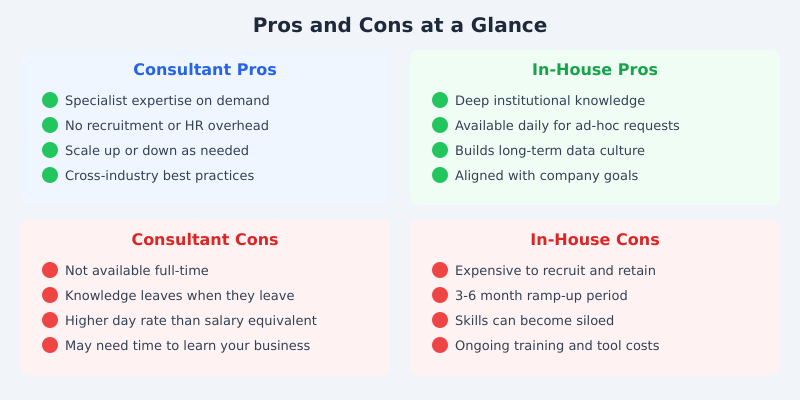
Head-to-Head Cost Comparison
Let me put real numbers side by side. I’ll compare two scenarios: hiring a mid-level analyst full-time versus engaging a consultant for 3 days per month (a common retainer arrangement for growing businesses).
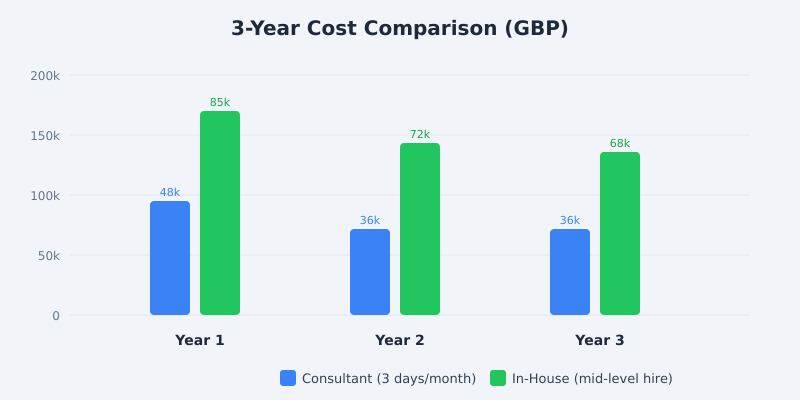
Year 1 comparison:
| Cost Element | In-House Analyst | Consultant (3 days/month) |
|---|---|---|
| Base compensation | GBP 45,000 | GBP 36,000 (GBP 1,000/day x 36 days) |
| Employer NI + pension | GBP 7,650 | GBP 0 |
| Recruitment | GBP 9,000 | GBP 0 |
| Tools and licences | GBP 8,000 | GBP 0 (uses your existing stack) |
| Training | GBP 3,000 | GBP 0 |
| Equipment | GBP 2,500 | GBP 0 |
| Onboarding productivity loss | GBP 10,000 (est.) | GBP 0 |
| Knowledge transfer docs | GBP 0 | GBP 12,000 (built into engagement) |
| Year 1 Total | GBP 85,150 | GBP 48,000 |
| Year 2 Total | GBP 72,000 | GBP 36,000 |
| Year 3 Total | GBP 68,000 | GBP 36,000 |
| 3-Year Total | GBP 225,150 | GBP 120,000 |
The consultant option costs roughly 47% less over three years in this scenario. But — and this is important — you’re getting 36 days of expert time per year versus 230+ days of a full-time employee. If your analytics needs require daily attention, the equation flips.
The UK Government’s employer cost research consistently shows that total employment costs run 30-40% above base salary, which aligns with these figures.
When to Hire an Analytics Consultant
Based on my experience on both sides, a consultant makes the most sense in these situations:
You need a specific outcome, not an ongoing function. Analytics audits, platform migrations, attribution modelling, or setting up a measurement framework — these are defined projects with clear deliverables. A consultant can complete them in weeks rather than months.
You need expertise faster than you can hire it. When Deliveroo needed to overhaul our attribution model, we couldn’t wait three months to find and onboard the right person. Specialist consultants — people who’ve done exactly that project before — can start delivering value in the first week.
You want to validate your strategy before committing. Before building a three-person analytics team, it makes sense to bring in someone who can assess what you actually need. I’ve saved clients significant money by recommending a simpler setup than they originally planned.
Your analytics needs are part-time. Many businesses, especially those with fewer than 200 employees, don’t generate enough analytics work to justify a full-time hire. Three to five days per month of expert time often covers it.
When to Build In-House
An in-house team makes more sense when:
Analytics is central to your business model. If you’re a data-driven company where analytics directly influences daily decisions — think e-commerce, fintech, or SaaS — you need people who live and breathe your data every day. At Deliveroo, the analytics team wasn’t a support function; it was embedded in product, marketing, and operations. That requires full-time, dedicated people.
You need someone available for ad-hoc requests. Stakeholders don’t always plan ahead. When the CEO asks for a quick analysis at 3pm on a Tuesday, you need someone who can deliver it by end of day. A consultant on a retainer can’t always provide that responsiveness.
You’re building a data culture. Institutional knowledge matters. An in-house analyst understands the quirks of your data, the history behind certain metrics, and the political dynamics of your organisation. This Harvard Business Review article on data culture explains why embedded expertise creates lasting competitive advantage.
You generate enough work for a full-time role. If your team is requesting 20+ hours of analytics work per week, you’ve crossed the threshold where a full-time hire becomes more cost-effective than a consultant.
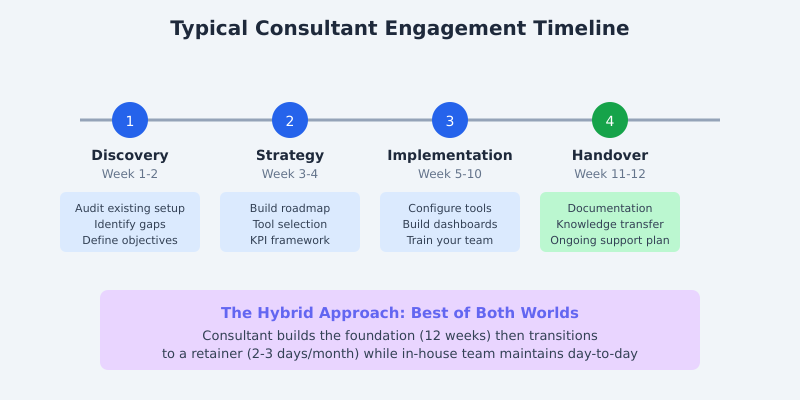
The Hybrid Approach: What Most Companies Should Do
Here’s what I recommend to most of my clients, and it’s the approach I’ve seen work best across dozens of engagements: start with a consultant, then transition to a hybrid model.
The pattern looks like this:
- Phase 1 (Months 1-3): Consultant runs a full discovery, builds the strategy, selects and configures tools, creates dashboards, and documents everything.
- Phase 2 (Months 4-6): Hire a mid-level analyst. The consultant trains them, transfers knowledge, and gradually reduces their involvement.
- Phase 3 (Month 7 onwards): In-house analyst handles daily work. Consultant drops to a retainer of 1-2 days per month for strategy reviews, complex projects, and quality assurance.
I used this exact approach with a Series B fintech company last year. They initially wanted to hire a Head of Analytics at GBP 80,000. Instead, I spent three months building their measurement framework, setting up Amplitude with proper event tracking, and creating a self-serve dashboard suite in Looker. Then they hired a strong mid-level analyst at GBP 48,000 who could maintain and extend what I built.
The result? They saved roughly GBP 30,000 in Year 1 compared to their original plan, and had a working analytics function three months sooner. I still support them two days per month for strategic guidance and complex analysis.
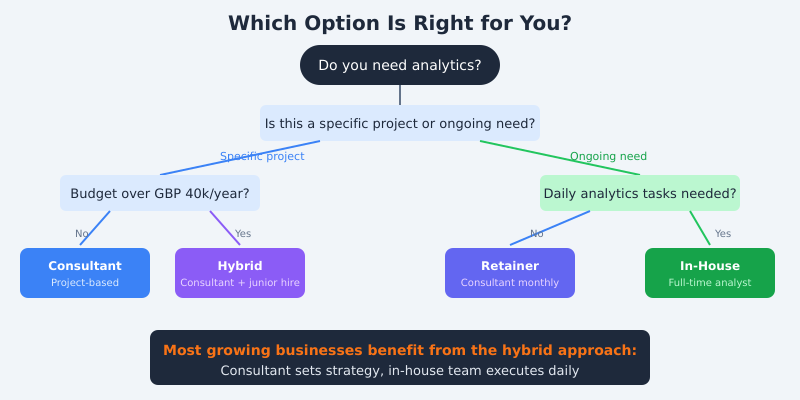
The McKinsey research on data-driven enterprises supports this staged approach, noting that organisations that combine external expertise with internal capability-building achieve faster time-to-value from their analytics investments.
Making the Right Decision for Your Business
Don’t let anyone tell you there’s a one-size-fits-all answer. The right choice depends on three factors:
- Volume of work: If you need less than 20 hours per week of analytics support, a consultant or retainer is probably more cost-effective.
- Nature of work: Strategic, one-off projects favour a consultant. Ongoing, operational analytics favours in-house.
- Budget reality: If you can’t afford the GBP 70,000+ true cost of a full-time hire in Year 1, a consultant lets you access senior expertise at a fraction of the commitment.
Having been the in-house analytics leader and the external consultant, I can tell you honestly: both models work. The question is which one works for your situation right now. And for many growing businesses, the answer is both — at different stages.
Frequently Asked Questions
How much does an analytics consultant cost in the UK?
UK analytics consultants typically charge between GBP 800 and GBP 1,500 per day, depending on seniority and specialisation. Project-based engagements range from GBP 15,000 to GBP 50,000, while monthly retainers usually cost GBP 1,600 to GBP 6,000 for 2-4 days of support. These rates reflect senior expertise with no employer overhead costs.
Can a consultant replace an in-house analytics team entirely?
For smaller businesses with part-time analytics needs, yes. A consultant on a 3-5 day monthly retainer can handle strategy, reporting, and optimisation. Larger organisations with daily analytics demands will still need in-house resources — but a consultant can complement them by handling strategic projects and providing specialist expertise.
How long does it take an analytics consultant to deliver results?
Most consultants deliver initial findings within 2-4 weeks of starting an engagement. A full analytics audit and strategy typically takes 6-8 weeks. Implementation projects like tracking setup or dashboard builds take 8-12 weeks. The key advantage is that consultants start productive immediately, whereas in-house hires need 3-6 months to ramp up.
What happens to analytics knowledge when a consultant leaves?
This is a legitimate concern. Good consultants build documentation and knowledge transfer into every engagement. I always deliver a handover pack including process documentation, training materials, and recorded walkthroughs. The hybrid approach mitigates this risk by having an in-house person learn alongside the consultant throughout the engagement.
Should a startup hire a consultant or an in-house analyst first?
Start with a consultant. Early-stage companies rarely generate enough analytics work for a full-time role, but they do need strategic foundations set correctly. A consultant can build your measurement framework, configure tools, and create initial dashboards in 2-3 months. Hire in-house once you have enough daily analytics work to justify the GBP 70,000+ annual commitment.
If you’re weighing up these options for your own business, I’m happy to have an honest conversation about what makes sense for your situation. Sometimes the answer is that you don’t need me at all — and I’ll tell you that too. Get in touch and let’s work it out together.