
“We’ve bought the tools. We’ve got the data. So why do we still wait three weeks for an answer?” That question, from a founder who’d spent a fortune on analytics software, captures the most common mistake I see growing companies make. They invest in analytics tools long before they invest in the right analytics team structure — and then wonder why the insights never arrive.
Over 15 years — from Tesco and Barclays to Head of Analytics at Deliveroo, and now consulting independently — I’ve helped companies build data teams from a single first hire up to functions of thirty-plus people. The pattern is remarkably consistent, and the order of hiring matters far more than most leaders expect.
This guide walks through the core roles in an analytics team, who to hire first, and how the structure should evolve as you scale — written for the leader signing off the headcount, not the recruiter writing the job spec.
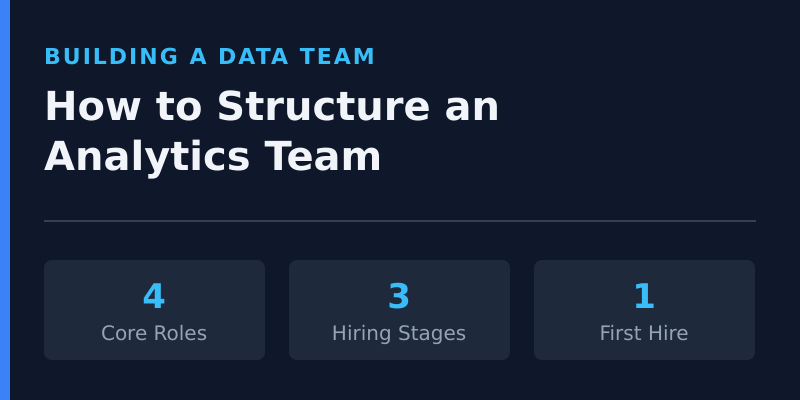
Why Structure Beats Headcount
The instinct, when data feels slow, is to hire more analysts. It rarely works. If your foundations are shaky, adding analysts just creates more people producing numbers nobody trusts. I’ve seen a five-person analytics team deliver less than a well-structured team of two, simply because the bigger team had no clear ownership and no clean data to work from.
Structure is about sequencing. Each role unblocks the next. Get the order wrong and you pay for it twice — once in salary, and again in the rework needed when you finally build the foundation you skipped.
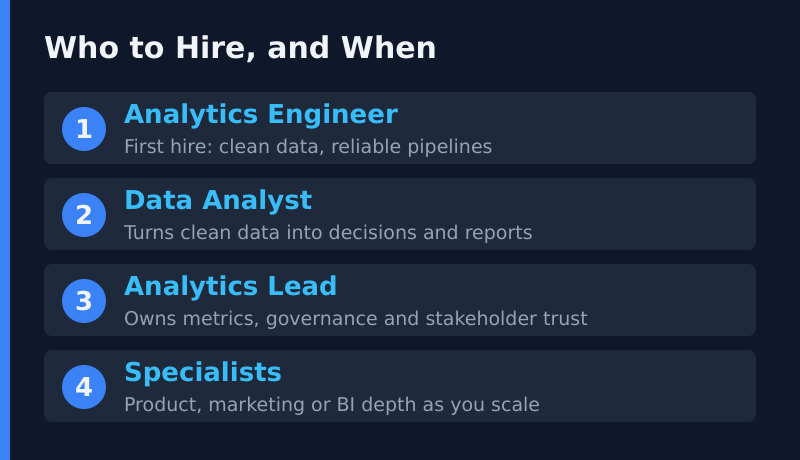
The Four Core Roles
Almost every effective analytics function is built from four role types. You won’t hire them all at once, and at small scale one person may wear several hats — but understanding the distinct jobs to be done is what stops you hiring the wrong person first.
1. The Analytics Engineer (Foundations)
This role makes the data trustworthy. They build reliable pipelines, model the raw data into clean, well-defined tables, and make sure “revenue” means the same thing everywhere. The discipline grew up around tools like dbt, which brought software engineering rigour to data transformation.
It’s unglamorous and invisible when done well — and it’s the single highest-leverage hire most companies skip. Everything downstream depends on it.
2. The Data Analyst (Decisions)
The analyst turns clean data into decisions. They build the reports, answer the business questions, and — most importantly — translate numbers into a story the rest of the company can act on. A good analyst is half technician, half communicator.
The common failure here is hiring a brilliant technical analyst who can’t explain their findings to a non-technical executive. The insight that nobody understands is worth nothing.
3. The Analytics Lead (Ownership)
The lead owns the metrics, the governance and the relationship with the rest of the leadership team. They decide what gets measured, defend the definitions, and protect the team from becoming a ticket-taking report factory. This role usually appears once you have three or more people.
4. The Specialists (Depth)
As you scale, you add depth: product analysts, marketing analysts, data scientists, or BI developers. These specialists go deep in one domain. Crucially, they only pay off once the foundations and ownership are in place — a data scientist on untrusted data is an expensive way to produce confident guesses.
Who to Hire First
Here’s where I disagree with conventional wisdom. Most companies hire a data analyst first, because they want answers now. But if your data is messy, that analyst spends 70% of their time cleaning and reconciling instead of analysing. You’ve hired a decision-maker and put them to work as a plumber.
Hire the analytics engineer before the analyst. Clean data makes one analyst as productive as three.
If you genuinely can only afford one person, look for a “full-stack” analyst who can do both — but be honest that you’re buying a foundation-builder first and an insight-generator second. The order, even within one person’s time, should be foundations then answers.
How the Structure Scales
- Stage 1 (1 person): One full-stack hire focused on clean data and a handful of trusted reports.
- Stage 2 (2–4 people): Split foundations from analysis — an analytics engineer plus one or two analysts, with a lead emerging.
- Stage 3 (5+ people): Add domain specialists and a dedicated lead. Decide between a centralised team or embedding analysts in business units.
That last decision — centralised versus embedded — deserves real thought. A centralised team keeps standards consistent but can become a bottleneck. Embedded analysts are closer to the business but risk drifting from shared definitions. Many mature teams settle on a hub-and-spoke model: a central team owns the data foundation and governance, while embedded analysts serve each function.
In-House or Outsourced?
You don’t have to build all of this internally on day one. Early on, a fractional or consulting partner can lay the foundations faster and cheaper than a permanent hire, then hand over to an in-house team once the patterns are set. I broke down the real cost trade-offs of each route in Hiring an Analytics Consultant vs. Building In-House.
Frequently Asked Questions
What’s the first analytics hire for a startup?
A full-stack analyst who leans towards data engineering. Their first job is making the data trustworthy; their second is answering questions. Hiring a pure analyst into messy data wastes most of their value.
When do we need an analytics lead?
Usually around the third hire, or when stakeholders start fighting over conflicting numbers. The lead exists to own definitions, set priorities and protect the team from becoming a report-on-demand service.
Should analysts sit in a central team or inside departments?
Both have merit. A hub-and-spoke model — central ownership of data and standards, with analysts embedded in functions — tends to give you consistency and closeness at once. It’s the structure most scaling teams converge on.
Key Takeaways
An analytics team is built from four roles — engineer, analyst, lead and specialists — and the order you hire them in matters more than the total headcount. Lay the data foundations first, add decision-makers second, and bring in specialist depth only once the basics are trusted and owned. Structure, not staff count, is what turns data into decisions.