A retail client once showed me their analytics setup with some pride: 312 tracked events, four dashboards, a data warehouse feed. Then the managing director asked which of their three delivery propositions was actually winning, and nobody in the room could answer. The data existed somewhere in those 312 events. No one had ever agreed what question it was collected to answer.
That is what a missing measurement plan looks like in practice. Not an absence of data — an absence of agreement. In fifteen years of analytics work I have seen far more businesses drown in unstructured tracking than starve for it, and the fix is almost never another tool.
A measurement plan is the document that connects what the business is trying to achieve to the specific numbers that will tell you whether it is happening. It is short, it is boring, and it settles arguments for a year.
What the Document Is For
The purpose is alignment, not documentation. A measurement plan forces the commercial side and the analytics side into the same room to answer one question per objective: how will we know this worked?
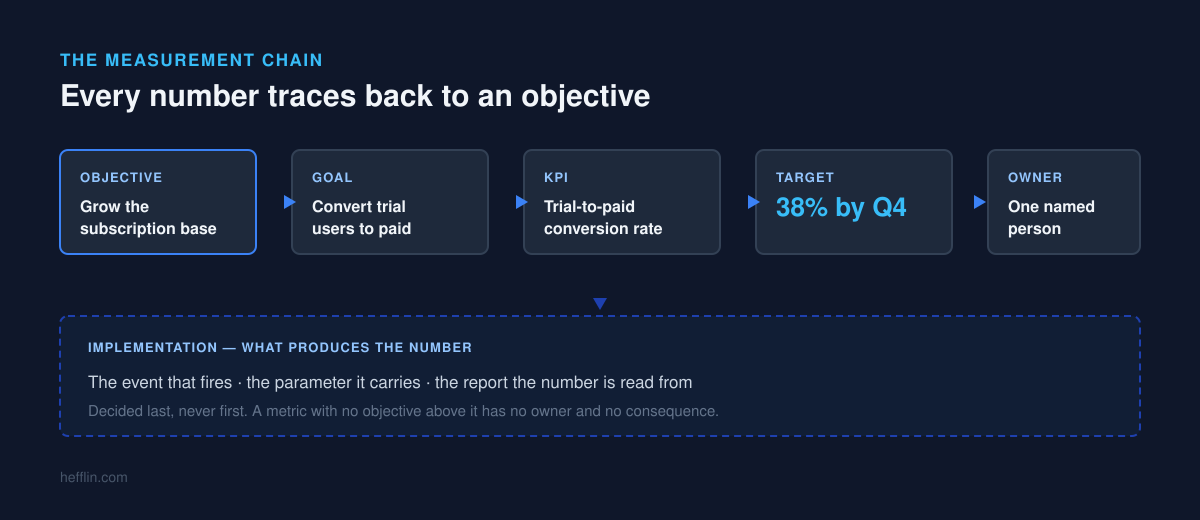
The framework most of the industry still builds on is Avinash Kaushik’s Digital Marketing and Measurement Model, which runs in five moves: identify the business objectives, identify goals for each objective, identify the key performance indicators, identify the targets, then identify the segments worth analysing. Kaushik draws a distinction people routinely blur — goals are the specific strategies you use to hit an objective, while a KPI is the metric that tells you how you are doing against it.
That distinction is the whole game. “Grow the subscription business” is an objective. “Convert more trial users into paid” is a goal. “Trial-to-paid conversion rate” is the KPI. “38% by Q4” is the target. Most of the plans I am asked to review skip straight to a list of metrics, which is why they never get used — a metric with no objective above it has no owner and no consequence.
Start From the Decision, Not the Dashboard
The most useful question I ask in a measurement workshop is not “what do you want to track?” It is “what decision will you make differently depending on this number?”
If the honest answer is none, the metric does not belong in the plan. It might still be interesting. Interesting is expensive: every tracked event carries implementation time, QA time, and a slice of someone’s attention every month it appears on a report.
Applied strictly, this question tends to cut a proposed list of 40 metrics down to about a dozen, and the dozen that survive are the ones with a name next to them. I have written before about how data-driven decision-making falls apart when nobody defined the decision first — the measurement plan is where that gets fixed, before a single tag is deployed.
The Table That Does the Work
Structurally, a working plan is a table. Mine has six columns, and I have never needed a seventh.
| Column | What goes in it |
|---|---|
| Business objective | The commercial outcome, in the language the board uses |
| Goal | The strategy meant to deliver it |
| KPI | One metric. Not three |
| Target | A number and a date, agreed by whoever owns the objective |
| Owner | A person, not a department |
| Implementation | The event, property or report that produces the number |
The last column is where analytics and strategy finally meet, and it is the one most commercial teams want to skip. It should name the specific mechanism — the event that fires, the parameter it carries, the report the number is read from. In GA4 that means deciding which events get marked as key events and which stay as ordinary events, a choice that is far easier when the KPI column already exists.
Who Needs to Be in the Room
A measurement plan written by the analytics team alone is a wish. It needs three parties present when the targets are set, and the absence of any one of them is visible in the finished document.
Someone with commercial authority has to be there, because only they can say which objective wins when two of them conflict. Someone who understands the tracking has to be there, because they are the person who knows that the number being promised is not currently collectable, or is collectable but wrong. And the person who will actually be held to the target has to be there — targets agreed in someone’s absence are targets nobody defends when the quarter goes badly.
Two hours with those three people beats two weeks of a document circulating by email. The plans I have seen collapse fastest were the ones where the KPI column was filled in by analysts guessing at what the board wanted, then sent upward for approval that arrived as silence. Silence is not agreement, and you find that out in the first review meeting.
This is also where basic governance earns its keep. Agreeing that “active customer” means one thing across the whole plan sounds trivial until finance and marketing produce different numbers for the same KPI in the same meeting.
Where These Plans Die
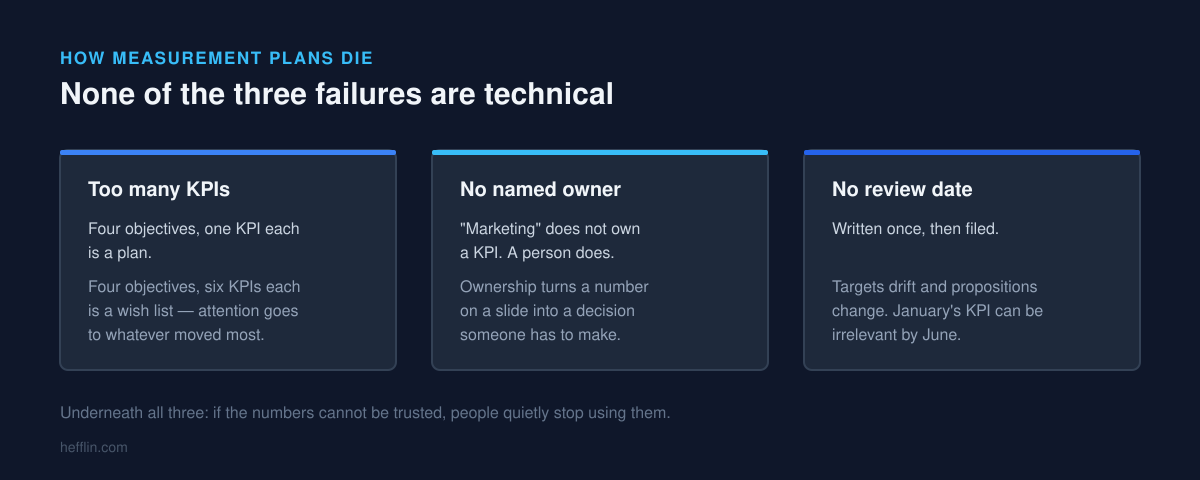
Plans fail in predictable ways, and none of them are technical.
- Too many KPIs. Four objectives with one KPI each is a plan. Four objectives with six KPIs each is a wish list. When everything is a priority, the monthly review becomes a reading exercise and attention goes to whichever number moved most, which is usually the least important one.
- No named owner. “Marketing” does not own a KPI. A person does. Ownership is what converts a number on a slide into a conversation about what somebody is going to do next.
- No review date. A plan written once and filed is a plan that describes last year’s business. Targets drift, propositions change, and a metric that mattered in January can be irrelevant by June.
There is a fourth failure that sits underneath all of these: the numbers cannot be trusted, so people quietly stop using them. If your tracking has known gaps, fix those before you promise the board a target — I have seen what an unreliable analytics setup does to the credibility of everything built on top of it.
Keeping It Alive After the Kick-Off
Treat the plan as a standing agenda item rather than a deliverable. Quarterly is the cadence that works for most mid-market businesses: review each objective, confirm the KPI still answers it, and either move the target or explain why it was missed.
Two rules keep it honest. Retiring a KPI needs the same conversation as adding one, otherwise the list only ever grows. And when an objective changes, the plan changes the same week — a measurement plan that lags the strategy by a quarter is worse than none, because it directs attention at things the business has already stopped caring about.
Where an organisation sits on the analytics maturity curve determines how much of this it can absorb at once. Early-stage teams should write three objectives and stop. Trying to plan measurement for the whole business before anyone has run a single quarterly review is how these documents end up in a folder nobody opens.
Where to Start This Quarter
Take your next board or leadership meeting agenda and write down the three commercial questions that get asked every time. Those are your objectives — you do not need a workshop to discover them.
For each one, agree a single KPI, a target with a date, and the person accountable for it. That is a page of A4, it takes an afternoon, and it will tell you immediately which of your existing tracked events earn their place and which 300 of them do not.