
Say “data governance” in a leadership meeting and watch the energy drain from the room. It sounds like committees, policy documents and red tape — the kind of thing that exists to slow everyone down. That reputation is exactly why most governance efforts fail. They’re built for auditors, not for the people who actually use the data.
I’ve spent 15 years inside analytics functions — at Tesco, Barclays, as Head of Analytics at Deliveroo, and now as a consultant — and I’ve come to a blunt conclusion. A data governance framework only works if it makes people’s lives easier. If it adds friction without removing confusion, it gets ignored within a quarter.
This is a practical framework for business leaders: four pillars that turn governance from a bureaucratic burden into the thing that finally makes your numbers trustworthy. No 40-page policy required.
What Data Governance Really Means
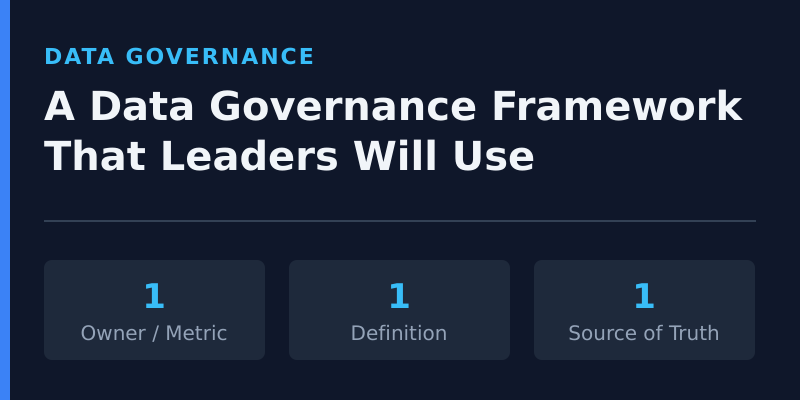
Strip away the jargon and data governance answers four simple questions: Who owns this number? What does it mean? Where does it come from? And who’s allowed to see it? That’s it. The Data Management Association’s body of knowledge formalises a great deal more, but for most organisations those four questions are 90% of the value.
The reason governance matters isn’t compliance — it’s trust. When nobody owns a metric and nobody agrees what it means, every decision rests on a number people quietly doubt. That doubt is expensive. I’ve watched whole strategies built on figures that turned out to be defined three different ways across three teams.
Pillar 1: Ownership
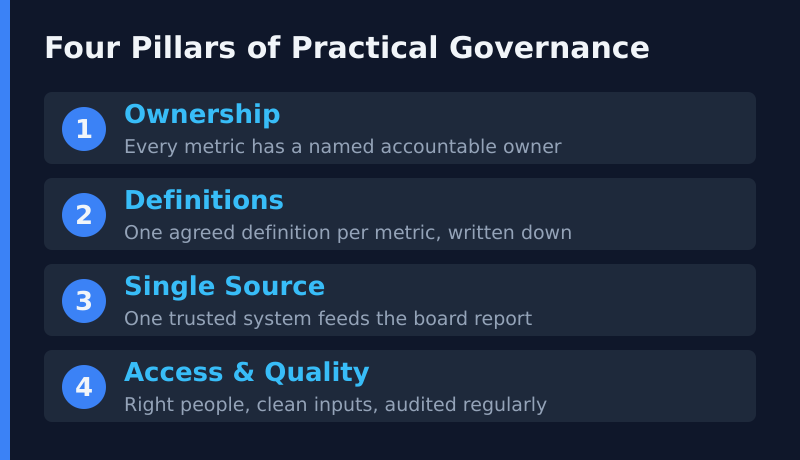
Every metric that matters needs a single, named, accountable owner. Not a team — a person. When something looks wrong, everyone should know exactly whose phone to pick up. Shared ownership is no ownership; if everyone’s responsible, nobody is.
This is the cheapest pillar to implement and the one most often missed. Make a simple list of your top fifteen metrics and write a name next to each. The conversations that surface — “wait, who actually owns churn?” — are themselves worth the exercise. Half the time, the answer is “nobody,” which explains a lot.
Pillar 2: Definitions
One agreed definition per metric, written down in plain language, accessible to everyone. This sounds trivial until you ask three teams to define “active user” and get three answers. Marketing counts anyone who opened an email. Product counts people who logged in. Finance counts paying accounts. All reasonable — and completely incompatible.
If two teams can’t agree what a metric means, you don’t have a data problem — you have a definitions problem wearing a data costume.
A shared metric catalogue — even a simple spreadsheet or wiki page — fixes this. Each entry: the metric name, its plain-language definition, how it’s calculated, and its owner. This single document prevents more bad decisions than any dashboard. Vague definitions are one of the quiet ways measurement gaps leak money, which I covered in The True Cost of Bad Data.
Pillar 3: A Single Source of Truth
For each decision, there should be one trusted system everyone looks at. Not the marketing team’s export, not finance’s spreadsheet, not the analyst’s personal dashboard — one agreed view that feeds the board report. When people pull the same number from different places, they get different answers, and meetings dissolve into reconciliation.
This doesn’t mean one giant system for everything. It means clarity about which source is authoritative for which question. The rule I give clients is simple: if a number appears in a leadership meeting, everyone must know which system it came from, and that system must be the agreed one.
Pillar 4: Access and Quality
The final pillar covers who can see what, and how you keep the inputs clean. Access is partly a security and privacy matter and partly a practical one — people need the data relevant to their job without drowning in everything else. Quality is the ongoing discipline of checking that the data feeding your trusted source is actually correct.
Quality is never “done.” It needs a regular audit rhythm — someone checking that tracking still fires, that definitions still hold, that no silent change upstream has broken a number. This connects directly to how you collect first-party data in the first place: clean inputs are far easier to govern than messy ones.
How to Start Without Boiling the Ocean
The biggest governance mistake is trying to govern everything at once. You write an enormous policy, hold a launch meeting, and watch it gather dust. Start small instead.
- List your fifteen most important metrics — the ones in board and leadership reports
- Assign each a named owner
- Write one plain-language definition and calculation for each
- Agree the single source of truth for each
- Set a quarterly review to keep it honest
That’s a week of work, not a year-long programme. And it delivers most of the trust governance promises, without the bureaucracy that kills it.
Frequently Asked Questions
Isn’t data governance only for large enterprises?
No. The smaller you are, the cheaper it is to get right, and the more painful it is to retrofit later. A ten-person company with clear metric ownership beats a thousand-person company arguing about whose number is correct.
Who should own data governance overall?
Whoever owns the analytics function — a head of data, an analytics lead, or in smaller firms a senior operator. The key is that someone is accountable for the framework itself, not just the individual metrics within it.
How is governance different from data quality?
Quality is one pillar of governance. Governance is the wider framework — ownership, definitions, single source of truth and access — that makes quality sustainable. You can’t keep data clean for long without the structure around it.
Key Takeaways
Good data governance isn’t a policy binder — it’s four practical pillars: clear ownership, agreed definitions, a single source of truth, and disciplined access and quality. Start with your fifteen most important metrics, give each an owner and a definition, and review quarterly. Governance done this way doesn’t slow your team down; it’s what finally lets them trust the numbers they’re deciding on.