
Search is changing faster than ever. With Google AI Overviews now appearing in over 50% of searches and 58.5% of searches ending without a click, the rules of SEO are being rewritten. In this guide, I’ll share practical strategies to maintain visibility and drive business results in this new zero-click landscape.
After 15 years in web analytics, I’ve seen many “SEO is dead” moments—none as significant as this one. But here’s what most guides miss: zero-click search isn’t a threat if you understand how to leverage it. The brands winning today are those treating AI Overviews as a distribution channel, not an obstacle.
What Are AI Overviews and Why They Matter
AI Overviews are AI-generated summaries that appear at the top of Google search results, synthesising information from multiple sources to answer queries directly. Powered by Google’s Gemini 2.0, they analyse context and present comprehensive answers without requiring users to click through to websites.
The impact is substantial:
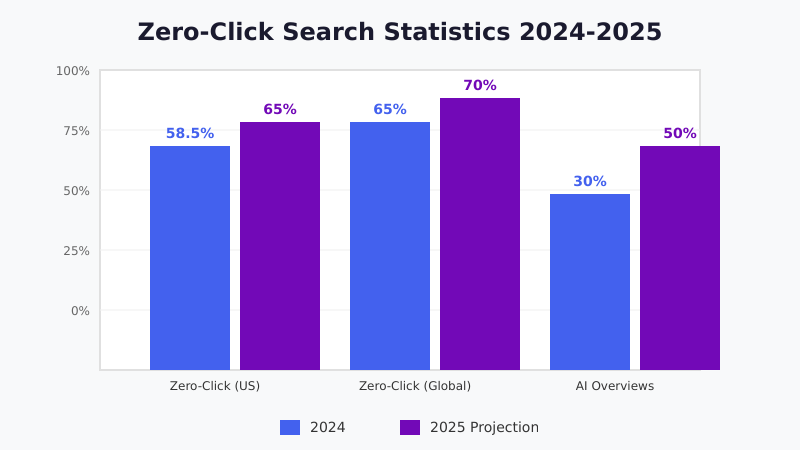
| Metric | 2024 | 2025 Projection |
|---|---|---|
| Zero-click searches (US) | 58.5% | 65%+ |
| Zero-click searches (Global) | 65% | 70%+ |
| AI Overview appearance rate | 30% | 50%+ |
| CTR decline from AI results | -30% | Increasing |
This shift has been called “The Great Decoupling”—where impressions rise but clicks fall. According to Bain & Company’s research, 80% of consumers rely on zero-click results at least 40% of the time.
The New SEO Mindset: From Rankings to Answers
Traditional SEO focused on ranking for keywords. AI-era SEO focuses on being the answer. This is a fundamental shift that requires rethinking how we measure success.
Here’s the key insight I share with clients: Google doesn’t discriminate based on ranking position when selecting AI Overview sources. A page ranking #15 can be cited if it provides the most relevant, well-structured answer. This democratises visibility in ways traditional SEO never did.
The new success metrics should include:
- AI citation rate: How often your content is referenced in AI Overviews
- Featured snippet presence: Capture of position zero results
- People Also Ask (PAA) visibility: Appearing in related questions
- Brand search volume: Users searching for you directly
- Search impressions: Visibility even without clicks
How to Structure Content for AI Extraction
LLMs don’t read content the way humans do. They scan, chunk, and extract meaning from structured text. The easier your content is to parse, the more likely it appears in AI summaries.
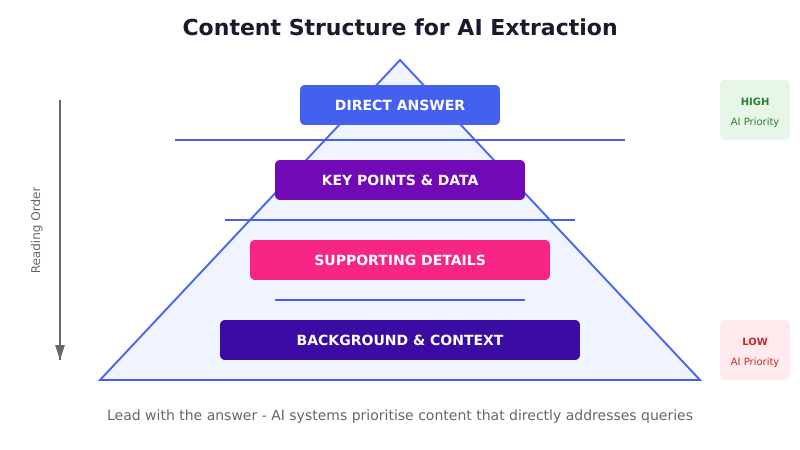
Lead with the Answer
Put your most important information first. AI systems prioritise content that directly answers the query without requiring deep reading. Use the inverted pyramid structure: conclusion first, then supporting details.
Use Clear Formatting
Structure matters more than ever:
- Bullet points and numbered lists: Easy to extract and display
- Tables: Ideal for comparisons and structured data
- Short paragraphs: 2-3 sentences maximum
- Descriptive headings: Use questions your audience asks
- Bold key terms: Helps AI identify important concepts
Include Definitive Statements
AI systems look for clear, authoritative answers. Compare:
| Weak | Strong |
|---|---|
| “There are various ways to approach this…” | “The most effective approach is X because…” |
| “It depends on many factors…” | “For most businesses, the best choice is X. Here’s why…” |
| “Some experts suggest…” | “Based on data from 500+ implementations, X delivers Y% improvement.” |
Technical Optimisation for AI Crawlers
AI crawlers depend on structure, schema, and accessibility to extract information. Pages implementing comprehensive structured data are roughly one-third more likely to be cited in AI-generated answers.
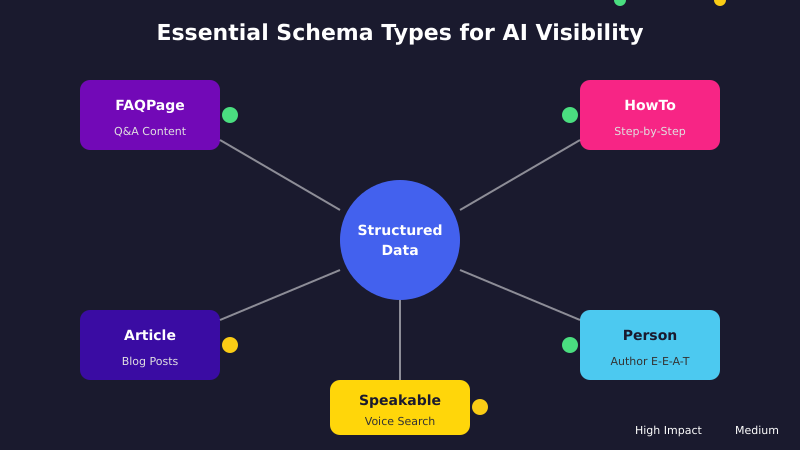
Essential Schema Types
Implement these schema types for maximum AI visibility:
| Schema Type | Use Case | Impact |
|---|---|---|
| FAQPage | Q&A content | High visibility in PAA boxes |
| HowTo | Step-by-step guides | Featured in how-to carousels |
| Article | Blog posts, guides | Establishes content type |
| Person | Author information | E-E-A-T signals |
| Speakable | Voice search | Audio assistant inclusion |
Example: FAQPage Schema
{
  "@context": "https://schema.org",
  "@type": "FAQPage",
  "mainEntity": [{
    "@type": "Question",
    "name": "What are AI Overviews?",
    "acceptedAnswer": {
      "@type": "Answer",
      "text": "AI Overviews are AI-generated summaries at the top of Google search results that synthesise information from multiple sources to answer queries directly."
    }
  }]
}
Consider an LLMs.txt File
Some SEOs are experimenting with LLMs.txt files—similar to robots.txt but providing structured instructions for AI crawlers. While not yet standard, it signals the direction the industry is moving.
Optimising for People Also Ask (PAA)
PAA boxes appear in approximately 75% of mobile and desktop searches—rising to 92% for informational queries. They absorb an estimated 15-20% of total search interactions.
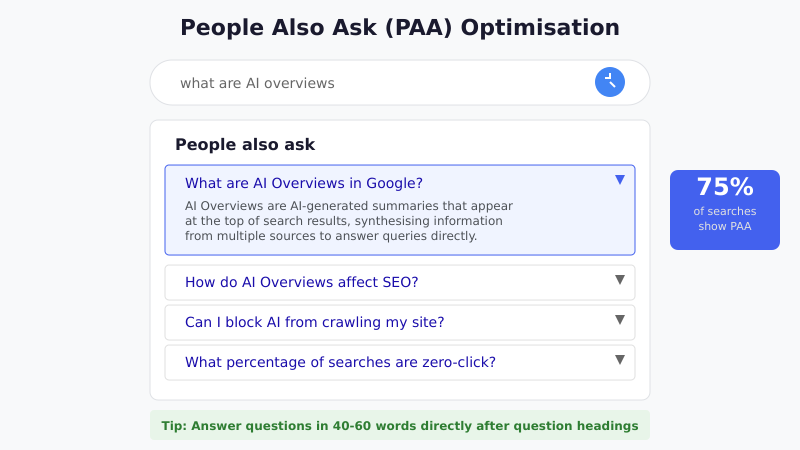
To optimise for PAA:
- Use question-based headings: Match the exact questions users ask
- Provide concise answers: 40-60 words immediately following each question
- Implement FAQ schema: Markup helps Google identify Q&A content
- Research PAA questions: Tools like AlsoAsked reveal related queries
- Create comprehensive coverage: Answer the main question and related questions
Building Entity Authority
AI systems increasingly rely on entity recognition—understanding who you are, what you’re known for, and whether you’re a credible source. This is where E-E-A-T (Experience, Expertise, Authoritativeness, Trustworthiness) becomes critical.
Strengthen Your Entity Presence
- Wikipedia presence: Cited frequently by AI systems
- Google Business Profile: Essential for local queries
- Wikidata entry: Structured entity information
- Consistent NAP: Name, Address, Phone across all platforms
- Author entities: Build individual expert profiles
Multi-Platform Presence
AI systems draw from multiple data sources. To maximise visibility:
- YouTube: Video content is increasingly cited
- Reddit: Now the third most visible website in SERPs
- LinkedIn: Builds professional authority
- Industry publications: Guest posts and expert quotes
- Podcasts: Audio transcripts feed AI knowledge
Content Strategies That Work in 2025
Go Beyond Text
Diversify content formats to maximise AI visibility:
- Video: Transcripts provide rich text for AI extraction
- Infographics: Visual summaries with alt text
- Interactive tools: Calculators, assessments, configurators
- Data visualisations: Charts and graphs with descriptive captions
Focus on Comprehensiveness
AI Overviews favour content that provides complete answers. Rather than thin content targeting individual keywords, create comprehensive resources that cover topics thoroughly. This aligns with the topic cluster approach I’ve used with SaaS clients—building authoritative hubs around core themes.
Maintain Human Quality
Google’s “scaled content abuse” policy penalises unedited or low-quality AI-generated text. Always have human editors review for:
- Factual accuracy
- Original insights and experience
- Tone and readability
- Up-to-date information
Common Mistakes to Avoid
- Ignoring structured data: Schema markup is no longer optional—it’s essential for AI visibility
- Thin content: Brief articles rarely get cited; comprehensive coverage wins
- Keyword stuffing: AI systems detect and penalise unnatural language
- Ignoring technical SEO: Site speed, mobile-friendliness, and crawlability still matter
- Only measuring clicks: Expand metrics to include impressions, citations, and brand search
- Neglecting E-E-A-T: Author credentials and source credibility increasingly determine visibility
Measuring Success in a Zero-Click World
Traditional SEO metrics need updating. Here’s what to track:
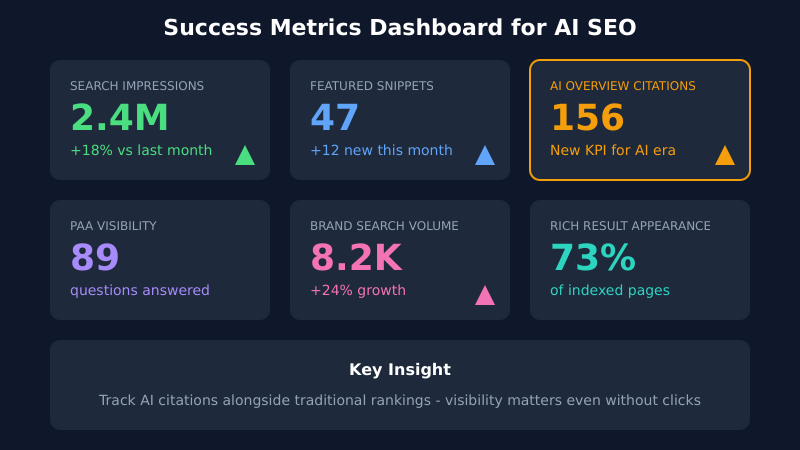
| Metric | Tool | Why It Matters |
|---|---|---|
| Search impressions | Google Search Console | Visibility even without clicks |
| Featured snippet presence | Semrush, Ahrefs | Position zero ownership |
| PAA visibility | AlsoAsked, Semrush | Question-based discoverability |
| Brand search volume | Google Trends, GSC | Direct interest generated |
| AI Overview citations | Manual tracking, Ziptie | New KPI for AI era |
| Rich result appearance | GSC Enhancements | Schema effectiveness |
At my consultancy, I’ve started including “AI citation presence” as a standard KPI alongside traditional rankings and traffic metrics. It’s a leading indicator of future visibility.
Frequently Asked Questions
Is SEO dead because of AI Overviews?
No. SEO is evolving, not dying. While clicks are declining for some queries, visibility and brand awareness opportunities are expanding. The key is adapting your strategy to optimise for AI citations and featured placements rather than just traditional rankings.
How do I check if my content appears in AI Overviews?
Currently, there’s no official tool from Google. Manual searching in incognito mode works for spot checks. Third-party tools like Ziptie and some enterprise SEO platforms are beginning to track AI citations. Monitor your branded search volume as an indirect indicator.
Should I block AI crawlers from my site?
Generally, no. Blocking AI crawlers reduces your visibility in AI-generated results. The exception might be premium content you want protected, but for most businesses, AI visibility is valuable. Focus on being cited rather than blocked.
Does page ranking still matter for AI Overviews?
Less than before. Google cites pages based on answer quality and relevance, not just ranking position. A page ranking #15 can be cited if it provides the best answer. However, domain authority and E-E-A-T signals still influence citation likelihood.
How long does it take to see results from AI SEO optimisation?
Structured data changes can impact visibility within weeks. Content restructuring typically shows results in 1-3 months. Building entity authority is a longer game—6-12 months for significant improvements. Start with quick wins like schema implementation while building long-term authority.
Getting Started: Your Action Plan
- Audit your structured data: Use Google’s Rich Results Test to check existing markup
- Implement FAQ schema: Add to your most important content pages
- Restructure top content: Lead with answers, use clear formatting
- Research PAA questions: Identify questions your audience asks
- Update success metrics: Add impressions and citation tracking
- Build entity presence: Strengthen author pages and external profiles
The zero-click future isn’t something to fear—it’s an opportunity to rethink how we create value through search. The brands that adapt will find new ways to reach audiences, build authority, and drive business results.
Have questions about optimising your site for AI search? Reach out at [email protected].